Oscar Wilde’s “The Happy Prince” (1888) is an Andersen-esque bedtime story that’s poetic, wryly humorous, richly melancholic, and playfully aestheticist (surface leads to depth: the statue of the Prince has the Swallow strip away his surface to substantively help those in need; the acts of sacrifice deepen the bond between the two). It’s deeply compassionate about the poor (when, some estimates have it, more than 25% of England was living in poverty) and slyly radical in its politics (socialist, anti-utilitarian, and homosocial). But it’s also, in one glaring blemish of a way, sadly conventional, even reactionary, for its time. Wilde is guilty, in his fable, of blatant anti-Semitism.
By the late 1800s, religious anti-Judaism had morphed into racial anti-Semitism (a term first used in the 1870s). Todd M. Endelman notes that, “in novels, newspapers, and the theatre, malicious or crude images of Jews were common fare. Charles Dickens, William Makepeace Thackeray, and Anthony Trollope, as well as dozens of less talented scribblers, unhesitatingly incorporated grasping, lisping Jews into their fiction and journalism.” But Jew-hatred in Victorian England only got pronounced, it seems, with the migration, from the 1880s to the 1910s, of 120,000 to 150,000 Eastern European Jews to England in the wake of Russian pogroms and other persecutions on the continent.
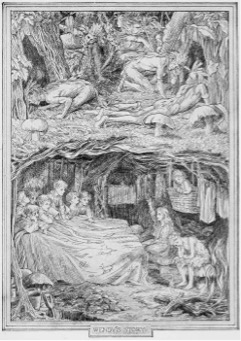
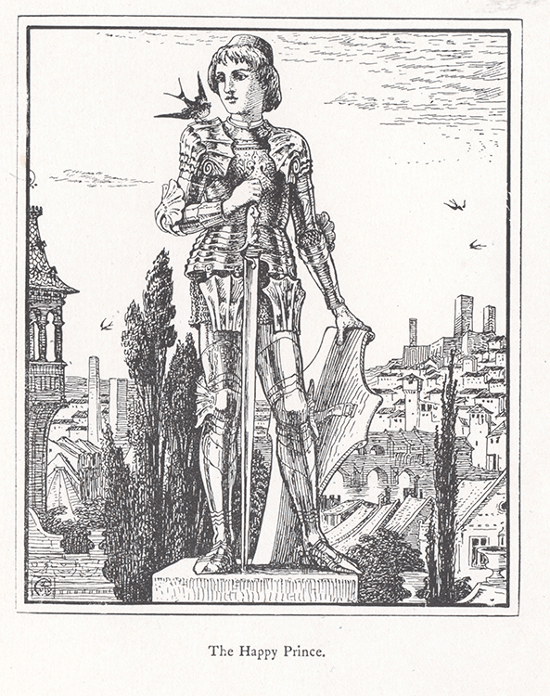
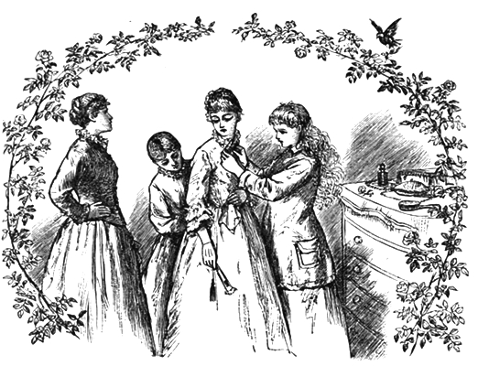
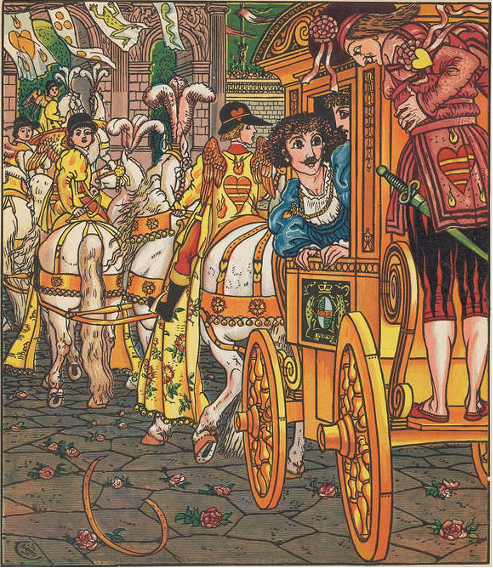
Walter Crane’s frontispiece for The Happy Prince and Other Tales, 1888
In Wilde’s story, as the Swallow flies with a ruby (from the Prince’s sword-hilt) to give to a poor seamstress (with a sick child), embroidering a gown for an ignorant, cruel Queen’s maid-of-honour (like so many at the time, she thinks of the poor as lazy), he “passed over the Ghetto, and saw the old Jews bargaining with each other, and weighing out money in copper scales. At last he came to the poor house and looked in. The boy was tossing feverishly on his bed, and the mother had fallen asleep, she was so tired.” And so the Jews, self-involved and utterly uncaring about the poor, are associated only with money and graspingly, greedily holding onto it.
And it got worse. A few years later, in The Picture of Dorian Gray, Wilde offered up even more vile anti-Semitism with the figure of a theatre manager, defined by Dorian Gray for Lord Henry by his Jewishness (e.g., “The Jew manager”) and not his name or character: “‘A hideous Jew, in the most amazing waistcoat I ever beheld in my life, was standing at the entrance, smoking a vile cigar. He had greasy ringlets, and an enormous diamond blazed in the centre of a soiled shirt. . . . There was something about him, Harry, that amused me. He was such a monster.’” (In some late twentieth-century editions of the novel—e.g., Dell Laurel, Signet—“Jew” is changed to “man”.) The manager, Mr. Isaacs, is much like a fairy-tale ogre from whom Sybil must be rescued by Dorian, “‘Prince Charming’”. Or he is a savage Other, like the beastly creature enslaved by Prospero in The Tempest: “the fat Jew manager who met them at the door was beaming from ear to ear with an oily, tremulous smile. He escorted them to their box with a sort of pompous humility, waving his fat jewelled hands, and talking at the top of his voice. Dorian Gray loathed him more than ever. He felt as if he had come to look for Miranda and had been met by Caliban.”
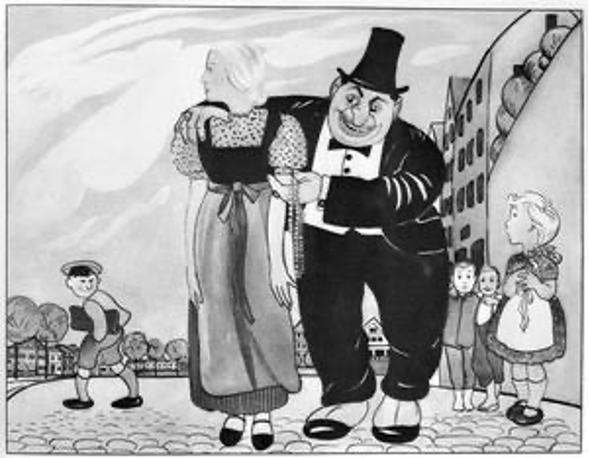
An anti-Semitic cartoon, by Philipp Rupprecht, depicting the Jew as corrupter of the innocent Aryan woman, from an interwar (c. 1920s) German schoolbook for children
Of course, by the time Wilde died of cerebral meningitis in Paris, in 1900—after his three infamous trials, his imprisonment and forced labour, his destitution, and his estrangement from his family—his name and works had become anathema to the public, so associated were they with homosexuality and degeneracy. And so that greater, Wilde-focussed public prejudice blotted out whatever pernicious influence the anti-Semitism in “The Happy Prince” and The Picture of Dorian Gray may have had. But modern anti-Semitism, particularly across Europe, helped bring the Nazis to power in Germany and led to the Holocaust. And Oscar Fingal O’Flahertie Wilde, though born into a Protestant family, must have been all too aware, growing up in Ireland, of how insidious, nasty, and dangerously effective prejudice against a group of people—reduced and demonized—could be. Sadly, he forgot that lesson in one of his (otherwise) great children’s stories.
Works Cited
Endelman, Todd M. The Jews of Britain: 1656-2000. U of California P, 2002.
Wilde, Oscar. “The Happy Prince.” 1888.
—. The Picture of Dorian Gray. 1891.
The author, a professor of literature, has written and published this blog post for educational, critical, and analytical purposes. All images are included only to bolster the post’s argument and to further its educational purpose.
Parents aren’t supposed to have one child they like more than the others, but what about authors? Many writers must have, at least for some of their books, a favourite among their fictional progeny—a character of which they’re not only especially proud but fond.
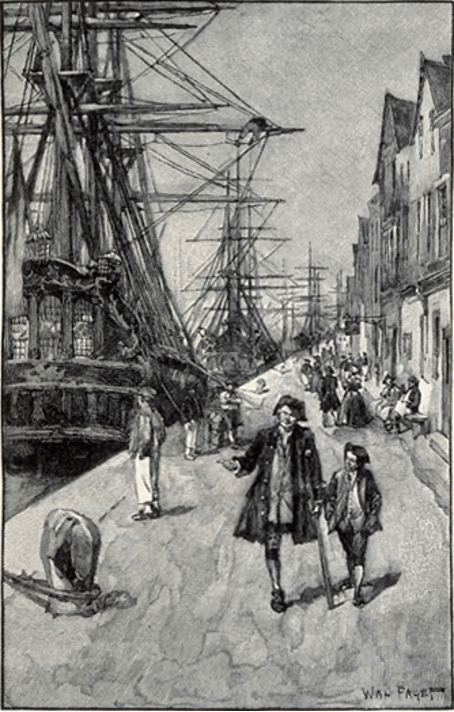
The stand-out (on one leg) character in Robert Louis Stevenson’s Treasure Island (1883) is Long John Silver. He’s introduced to us, via letter, by the slightly foolish, credulous Squire Trelawney, who calls him “a man of substance” and speculates, with what seems like more than passing racism, that it is Silver’s wife, “as she is a woman of colour”, who “sends him back to roving”. That “roving” will be launched on the Hispaniola, taking Captain Smollett, Trelawney, Dr. Livesey, Jim Hawkins, and their crew of hired hands, with Silver as the cook, to the treasure on the map that Jim took from the murdered Billy Bones’s sea chest in his mother’s seaside inn.
Long John Silver and Jim Hawkins (illustration by Walter Paget, 1899)
Jim, concerned that Silver could be that dreaded “one-legged sailor” whom Bones once told him to watch out for, upon first meeting Silver finds him to be a pleasant, affable fellow. But soon, aboard the ship, hiding in an apple barrel, he overhears the peg-legged plotter’s plan to kill Smollett, Trelawney, Livesey, and co., and split the treasure with his fellow mutineers. Then, on the island, from a hiding-spot he sees, to his horror, just what Silver is capable of:
With a cry, [Silver] seized the branch of a tree, whipped the crutch out of his armpit, and sent that uncouth missile hurtling through the air. It struck poor Tom [an honest hand], point foremost, and with stunning violence, right between the shoulders in the middle of his back. His hands flew up, he gave a sort of gasp, and fell.
. . . Silver, agile as a monkey, even without leg or crutch, was on the top of him next moment, and had twice buried his knife up to the hilt in that defenceless body. From my place of ambush, I could hear him pant aloud as he struck the blows.
Silver, then, is a charmer, a dissembler, a schemer, a double-crosser, a mutineer, and a murderer. Yet we, like Jim, cannot look away, because he’s the adventure’s most fascinating character: so cool under fire, charming, devious, and wily. He’s the utterly compelling anti-hero who gave the book its original title The Sea Cook, who eclipses young hero Jim—questioning the basic notion of Treasure Island as a “boy’s book”—and who bothered some critics at the time, with more than one thinking the novel not “wholesome”. The unnamed reviewer in The Athenaeum felt that Silver should not have “got off”, that is, escaped Smollett, Hawkins, and co. when the Hispaniola docks at a port in Spanish America on the return home. Silver teaches Jim, and the child reader, that one seen anew as a “monster”—as Jim sees Silver on witnessing his murder of Tom—is very much a man, too. Silver acts fatherly to Jim and relies on him, more than once, to trust him, and Jim does see him as “twice the man” that the rest of the pirates are. And Stevenson leaves him out there, beyond the confines of the narrative, roaming and “roving” alive and free.
Long John Silver and Jim Hawkins (Walter Paget, 1899)
It’s Silver who, in Stevenson’s fable “The Persons of the Tale” (1895), steps outside the narrative, along with Captain Smollett, to take a smoke-break: “After the 32nd chapter of Treasure Island, two of the puppets strolled out to have a pipe before business should begin again, and met in an open place not far from the story.” In the novel, it’s Silver who, in his speech, warps and reshapes, as Emma Letley has noted, in a sign of distorted morality, our sense of “duty” as “‘dooty’”; “Deposed” is written in a Bible by the pirates as “Depposed”, which happens to emphasize how much Silver is posing, or acting; it’s the scoundrel of a sea cook who warps and reshapes our romantic sense of pirates, with his shiftiness, amorality, and roguish charm drawing us in as often as it appalls us. In “The Persons of the Tale”, a sly bit of metafiction with no comforting moral, Stevenson dives deeper into romance and fiction to more profoundly question reality, morality, and religion. Smollett and Silver talk of an “‘Author’” as if he’s God, but Silver’s point that “‘if the Author made you, he made Long John’” has us doubt God’s morality, especially since, as Silver declares, “‘if there is sich a thing as a Author, I’m his favourite chara’ter. He does me fathoms better’n he does you—fathoms, he does. . . . he’s on my side, and you may lay to it!’”. What does it mean when the darkest character is also the deepest, most enthralling, and, here, most self-aware (“‘I’m on’y a chara’ter in a sea story. I don’t really exist.’”)?
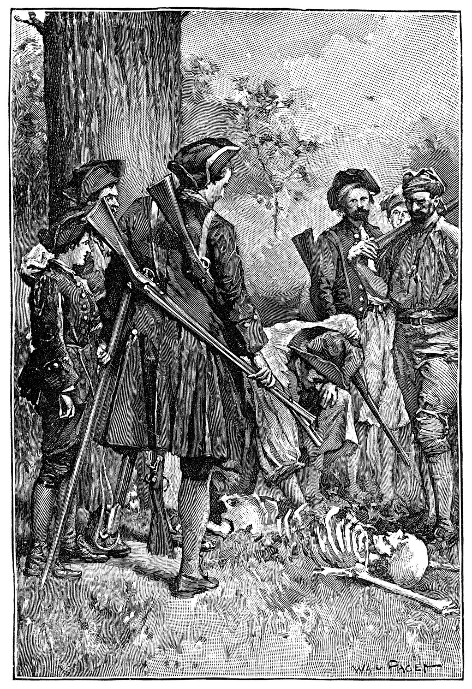
Long John Silver, Jim Hawkins, and the mutineers finding only bones (Walter Paget, 1899)
In his inimitable way, then, Stevenson’s favourite—and one of literature’s great villains—not only rends asunder any reassuring, escapist notion of a “boy’s adventure story” but turns the book into an anti-heroic anti-romance. (He is a darker reflection of Jim, whom he calls “‘the picter of my own self when I was young and handsome’”.) After all, when Silver escapes, at the end of the novel, taking a sack of coins with him, no-one wishes to pursue and re-capture him—they are mainly relieved that he’s no longer their concern: “I think we were all pleased to be so cheaply quit of him” (these are hardly heroes, then!). And it is largely because of Silver that Jim—who had “felt in this delightful dream” while “bound for an unknown island, and to seek for buried treasures!”—now, he remarks at story’s end, has his “worst dreams”, he tells us, “when I hear the surf booming about [Treasure Island’s] coasts, or start upright in bed, with the sharp voice of [Silver’s parrot] Captain Flint still ringing in my ears: ‘Pieces of eight! pieces of eight’”. The metallic-named Silver takes the shine off buccaneering for Jim and for us; it’s the beguiling backstabber and cutthroat who makes it so horridly, unforgettably clear that a pirate’s treasure is blood-money, not just ill-gotten but murderously won. As Peter Hunt notes, such critics as Alistair Fowler and Naomi J. Wood have pointed out the novel’s “connotation of corruption and debasement attached to silver in a [1700s] world moving to the gold standard”; even Jim, Hunt observes, reflects on the cost of the booty when he is sorting through it: “what blood and sorrow . . . what shame and lies and cruelty”.
And so LJS is RLS’s favourite because he is the high-wire character, more than any other in the author’s works, who reveals the electric current of realism through romance, the darkness running through fiction that only seems mere child’s play.
Works Cited
Hunt, Peter. Introduction. Treasure Island, by Robert Louis Stevenson, Oxford UP, 2011, pp. vii-xxxi.
Letley, Emma. Introduction. Treasure Island, by Robert Louis Stevenson, Oxford UP, 1998, pp. vii-xxiii.
Paget, Walter, illustrator. Treasure Island, by Robert Louis Stevenson, Cassell, 1899.
Stevenson, Robert Louis. “A Fable: The Persons of the Tale.” 1895. Appendix 2 in Treasure Island, edited by Peter Hunt, Oxford UP, 2011, pp. 192-94.
—. Treasure Island. 1883 [first book edition]. Oxford UP, 1998.
The author, a professor of literature, has written and published this blog post for educational, critical, and analytical purposes. All images are included only to bolster the post’s argument and to further its educational purpose.
—the narrator, of Beth’s imminent death, in Little Women
“The past is a foreign country: they do things differently there.” So begins L. P. Hartley’s The Go-Betweens (1953), but those words apply only too well to a deeply mid-nineteenth-century American book, Little Women (1868-69), brought to life on screen for nearly every new generation since the Gilded Age, with film versions in 1918, 1933, 1949, 1994, and 2019. (Of course, big-screen historical dramas and literary adaptations tend to reflect their own times.) Louisa May Alcott’s two-volume saga of the March sisters (published as Little Women and Good Wives in the UK) and their mother (“Marmee” to her girls) is most decidedly of its place and time—the volumes are set in a small Massachusetts town in 1861/62 and 1866-67—in four ways that seem curious, odd, and even discomfiting now.
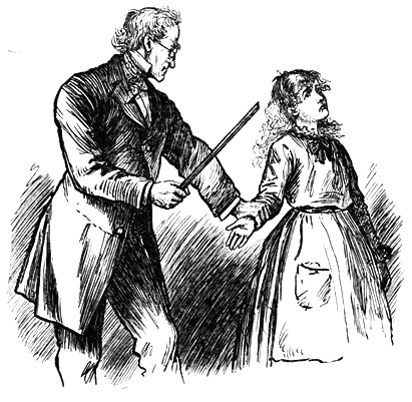
The first is the caning of Amy at school, in the chapter “Amy’s Valley of Humiliation” (one of many references to John Bunyan’s 1678 Christian allegory The Pilgrim’s Progress, important to Alcott’s father and a book he passed on to his daughters). The blonde, youngest March sister is caught with pickled limes by her teacher, Mr. Davis, who rather favours Amy but “had declared limes a contraband article.” (Each March sister has her burden[s] to overcome and eventually embodies an ideal of nineteenth-century American Protestant womanhood; Amy’s burdens are selfishness and materialism, and she comes to represent piety.) Mr. Davis takes the ruler to Amy, then makes her stand before the class until recess. Amy, vowing to not return, goes home, where an “indignation meeting” is held. Jo delivers a letter from their mother to Mr. Davis; Mrs. March, disapproving of corporal punishment, Mr. Davis’s teaching, and of the girls with whom Amy is consorting, says that Amy will study with Beth (and Mrs. March will “‘ask your father’s advice before I send you anywhere else’”). So far, so understandable (and remarkably patriarchal—Mr. March is off at war!). But then Mrs. March tells Amy, “‘I am not sorry you lost [the limes], for you broke the rules, and deserved some punishment for disobedience.’” She continues, “‘I should not have chosen that way [standing in disgrace before the class] of mending a fault . . . but I’m not sure that it won’t do you more good than a milder method. You are getting to be altogether too conceited and important, my dear, and it is quite time you set about correcting it. . . . conceit spoils the finest genius. . . . the consciousness of possessing and using [talent] well should satisfy, and the great charm of all power is modesty.’” Humiliation is turned by the matriarch into a necessary humbling; the wrongness of corporal punishment is righted and rewritten into a homily and lesson about the Christian virtue of humility. And so, in Alcott’s constantly educative book, family provides the best education of all—Amy does not need the institution of school.
Amy bore without flinching several tingling blows
(Drawing by Frank T. Merrill for the first illustrated edition [1880] of Little Women)
(In the 1994 film, Amy’s victimization is emphasized, with Mr. Davis made a sexist brute. The caning isn’t shown but Amy [Kirsten Dunst] is afterwards, crying and telling Jo [Winona Ryder] outside their wealthy aunt’s house, “Teacher struck me.” Then, with all gathered in the kitchen as loyal servant Hannah bathes Amy’s wealed hand, Amy explains what happened while Marmee [Susan Sarandon] and Jo pace angrily about; Amy notes, “Mr. Davis said it was as useful to educate a woman as to educate a female cat.”)
(In the 2019 film, Amy’s punishment is a means for drawing the Marches together, hinting at romance, and emphasizing female creativity. The aspiring artist, to gain more limes from and have her lime-debt erased by a classmate, caricatures Mr. Davis on her slate and is caught. [This reworks a moment in the book, when Amy recalls Mr. Davis catching and punishing a classmate who had caricatured him.] Cut to a tutored Laurie [Timothee Chalamet] finding Amy [Florence Pugh] outside the Laurences’ house, wailing. She comes in, acts the lady in the library, charming Laurie [hinting at their romance and marriage]; Meg [Emma Watson] arrives, catching the eye of tutor Mr. Brooke [hinting at their marriage]; Jo [Saoirse Ronan]—her writing career is the film’s focus—arrives to marvel at the books; Marmee [Laura Dern] arrives, telling Amy that she will take her out of school, and Jo will teach her.)
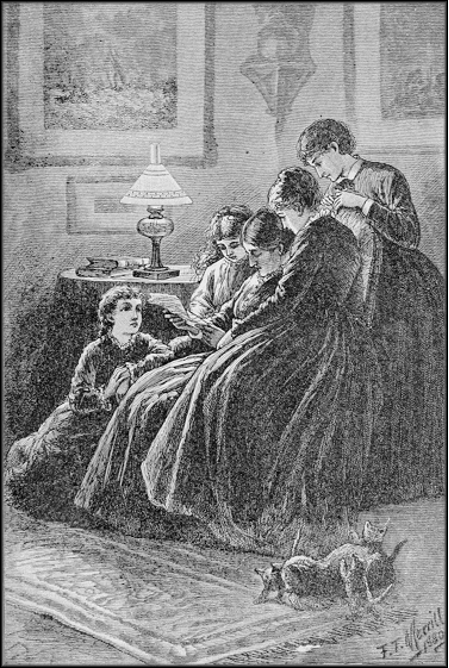
“They all drew to the fire, mother in the big chair, with Beth at her feet” (Drawing by Frank T. Merrill for the first illustrated edition [1880] of Little Women)
The second is the attitude of Little Women to alcohol. After Meg (burdens: vanity and disdain for housework; comes to represent purity and learns to value the home) gets drunk on champagne at a party, and Jo is “‘glad you [Laurie] were not in the saloon, because I hope you never go to such places’”, Meg, at her wedding, notes to Laurie, now in his late teens, that her father only thinks wine should be for the ill, while her mother “‘says that neither she nor her daughters will ever offer it to any young man under her roof.’” Laurie then promises the newlywed Mrs. Brooke and Jo that he will be abstemious, “for which,” the narrator notes, “he thanked them all his life”. Thus the book, implying that alcohol is irreligious, makes its pro-temperance stance.
Abstinence-pledging groups, in which women were prominent, had begun in the 1840s. Temperance, largely a Protestant and rural (and anti-urban) crusade, was soon led by the Women’s Christian Temperance Union and the male Anti-Saloon League, and associated alcohol with sinfulness. (It all culminated, of course, in Prohibition.) But temperance was also a means of talking (indirectly) about and fighting abuse and marital rape in the home. Working-class and immigrant populations, though, were targeted; Irish and Italians, especially, and other cultures where alcohol was important were hurt by liquor bans and “dry” campaigns. Anti-Irishness is played for laughs in Little Women with Beth’s meant-to-be-comic portrait of a poor, hungry Irishwoman getting a fish from Mr. Laurence (“‘Oh, she did look so funny, hugging the big, slippery fish, and hoping Mr. Laurence’s bed in heaven would be “aisy.”’”) and the narrator’s meant-to-be-comic listing of some rural creatures: “Laurie [threw] up his hat and [caught] it again, to the great delight of two ducks, four cats, five hens, and half a dozen Irish children”.
(In the 1994 film, drinking is turned into a criticism of the patriarchy. Laurie [Christian Bale] makes no promise of abstinence at Meg’s wedding, but he does see Meg [Trini Alvarado], at a ball in Boston, vainly going along with a snobby, patrician crowd and drinking champagne, which he takes from her, remarking, “Miss March—I thought your family were temperance people.” Back at home, before bed, Meg asks her mother, “Why is it Laurie may do as he likes, and flirt and tipple champagne, and no-one thinks the less of him?” “Well,” Marmee replies, “I suppose for one practical reason: Laurie is a man, and, as such, he may vote, and hold property, and pursue any profession he pleases. And so he is not so easily demeaned.”)
(In the 2019 film, drinking isn’t looked down on at all—indeed, in Greta Gerwig’s script, as if channeling Gerwig’s whirling, carefree characters in Damsels in Distress or Frances Ha, Meg is described, at the party, as “done up nearly beyond recognition. She’s powdered and corseted and drinking and flirting. In fact, she’s kind of great at it.”)
The First Wedding
(Drawing by Frank T. Merrill for the first illustrated edition [1880] of Little Women)
The third is marriage—it needs parents’ approval and needn’t be for love (you wouldn’t know that at all from the 1994 and 2019 film versions), because love can come after it. In Alcott’s book, Mrs. March tells Jo of how John Brooke, Laurie’s tutor, talked to her and her husband about his love for Meg: “‘He only wanted our leave to love her and work for her, and the right to make her love him if he could’” (my emphasis). And the narrator discloses to us the matriarch’s final words to herself in that chapter, “Confidential”, as if they are a tender aside to the reader: “Mrs. March said, with a mixture of satisfaction and regret, ‘She does not love John yet, but will soon learn to.’” (Those final words would sound ominous today in a sci-fi or horror movie.) And, later, Mrs. March is relieved to hear that Jo doesn’t love Laurie “‘anything more’” than she always has—that is, as a dear friend—because, she says, “‘I don’t think you suited to one another. . . . I fear you would both rebel if you were mated for life. You are too much alike, and too fond of freedom, not to mention hot tempers and strong wills, to get on happily together, in a relation which needs infinite patience and forbearance, as well as love.’” Then Jo says of Laurie, to Beth, “‘Amy is left for him’”! It’s as if one of the eligible sisters, so much of a March-ness, will do for Laurie. Laurie even explains to Jo (burdens: anger and dislike for womanhood; comes to represent feminine decorum) his marriage to Amy thus: “‘Amy and you change places in my heart, that’s all’.” (Imagine any newlywed man saying that today to his sister-in-law!)
Mrs. March would not leave Beth’s side
(Drawing by Frank T. Merrill for the first illustrated edition [1880] of Little Women)
The fourth is Beth’s death, which is really not so sad, because of the family’s faith and because the death is so spiritually transfiguring for another sister. Beth, whose burden is shyness, comes to represent submissiveness—to fate, to death, and so to God. She is the March sister who embodies meekness, too, and is that ideal nineteenth-century “angel in the house”—a term even used to describe her. And Beth is Exhibit B of the nineteenth-century literary trope of the holy child dying (made most famous by Dickens, with the death of Little Nell), a sentimental tradition that transforms Jo, the sister most devoted to her, marking the death of her girlhood. We know that Beth’s death is not all that sad, but preordained—part of the author’s (and God’s?) plan—because it’s foreshadowed in Chapter 4, “Burdens”: “There are many Beths in the world, shy and quiet, sitting in corners till needed, and living for others so cheerfully, that no one sees the sacrifices till the little cricket on the hearth [an allusion to Dickens] stops chirping, and the sweet, sunshiny presence vanishes, leaving silence and shadow behind.”
With her head in Jo’s lap, while the wind blew healthfully over her (Drawing by Frank T. Merrill for the first illustrated edition [1880] of Little Women)
In a book rife with lessons, Jo learns patience, charity, loyalty, and faith from Beth’s death, and pledges herself to a better ambition—immortal love, for God. As her younger sister nears the end of her seventeen years on earth, Jo pens a poem, “My Beth”, in which she calls Beth that “‘serene and saintly presence’” who “‘Sanctifies’” the “‘home’”, asks to be given some of her courage and unselfishness, which will make “‘our parting daily loseth / Something of its bitter pain’”, hopes that grief will make her “‘wild nature more serene’”, and looks ahead to renewed “‘Hope and faith, born of my sorrow’”, with Beth’s death thus showing the way to “‘home’”, that is, Heaven. (Perhaps it is altogether too poetic that “Beth” rhymes with . . .) Death is beautiful in that it brings you to God. The narrator tells us, after noting how “a bird sang blithely on a budding bough . . . the snow-drops blossomed freshly at the window, and the spring sunshine streamed in like a benediction over the placid face upon the pillow”, that Mrs. March, Meg, Jo, and Amy “thanked God that Beth was well at last”—it marks an end to her earthly suffering. Beth’s death—at a time when so many American children died young—is so much of a religiously-understood departure and comfort (and not, by today’s standards, a grief-filled tragedy or loss not-to-be-gotten-over) that Amy’s acceptance of Laurie’s proposal comes just a dozen pages after it, at the end of the next chapter, “Learning To Forget”. Even on the second-last page of the book, when we learn that Laurie and Amy’s one girl (called, yes, Beth!) may die young, the narrator tells us that, should she, it will only bring them closer: “the shadow over Amy’s sunshine . . . was doing much for both father and mother, for one love and sorrow bound them closely together.” Not only is death never the end, but it offers, for those who remain, betterment and renewal.
The Valley of the Shadow (Drawing by Frank T. Merrill for the first illustrated edition [1880] of Little Women)
(In the 1994 film, Beth’s death is a simple tearjerker, its staged and secular sadness sanctifying Jo. Marmee sobs after telling Jo that Beth [Claire Danes], pallid and propped up on pillows, has, she thinks, “been waiting for you.” Mother and daughter embrace; cut to Beth, eyes shining happily as Jo feeds her broth, then seeming better as Jo performs a reading for her. Yet Beth, voice cracking, diminishes herself and raises Jo up: “I never saw myself as anything much. I’m not a great writer, like you . . . you will be [a great writer]. . . . I can be brave, like you. But I know I’ll be homesick for you, even in heaven.” Then, when Jo shuts the window and looks out at the howling wind and the trees, the music swells, she turns, and her sister has died. The next morning, Hannah drops petals on Beth’s empty bed and her dolls. There is no sense of Beth going to heaven. When Jo asks, in the very next scene, “Will we never all be together again?”, there is no answer from her mother or father, dressed in black. There is only silence in the house.)
(In the 2019 film, Beth’s death is all about Jo’s loss and memory, burnished by shots and cuts, sanctifying cinema itself. In a flashback, Jo remembers lying in bed with a gravely ill Beth [Eliza Scanlen] and telling her to “please fight”, then waking up to come downstairs and find her all better; another flashback, sun-lit, recalls Mr. March coming home from the war. But then, in the present, amid blues and greys, Jo comes downstairs to find Marmee crying and Beth not at the table—Marmee is so distraught that she reaches out for and presses herself into Jo, and it is the child who holds the parent. There’s no sense of God; no words console. The next scene, also wordless, begins with a long shot of Mr. and Mrs. March, Jo, Meg, and a few others standing by Beth’s grave, in the woods, and ends with a close-up of Jo, just staring down; cut to a flashback where Jo’s looking at Beth, decorating outside the home for Meg’s wedding. And so, better than Jo the writer could do [as grief is shown to be beyond words], Gerwig the auteur’s film—with its flashbacks and crosscuts—finds comfort and sadness . . . in secular, cinematic memory.)
Louisa May Alcott’s Little Women is a domestic story that is, in the end and in all of its characters’ endings, earnestly sunny, for it believes in a home after ours, one where the “Heavenly Father”, as Marmee tells her girls, has such “strength and tenderness”. All the “little women” are married off, including Beth, as she is bound to die and so be with that “Friend who welcomes every child with a love stronger than that of any father, tenderer than that of any mother.” Marmee tells Jo that, after loving those here among us, “‘the best lover of all comes to give you your reward.’” Today, perhaps only a Christian film-industry production could offer an adaptation of Little Women truer to Alcott’s time, nestling us closer to the book’s homey, Protestant values.
Works Cited and Consulted
Alcott, Louisa May. Little Women. 1868-69. Edited by Valerie Alderson, Oxford UP, 1998.
Alderson, Valerie. Explanatory Notes. 1994. Little Women, by Louisa May Alcott, Oxford UP, 1998, pp. 474-89.
Little Women. Directed by Gillian Armstrong, Columbia, 1994.
Little Women. Directed by Greta Gerwig, Sony, 2019.
Merrill, Frank T., illustrator. Little Women, by Louisa May Alcott, Roberts Brothers, 1880.
The author, a professor of literature, has written and published this blog post for educational, critical, and analytical purposes. All images are included only to bolster the post’s argument and to further its educational purpose.
In English, “Grimm” seems like a classic case of nominative determinism (I am named, therefore I am). Just riffle through any Brothers Grimm anthology for proof of the German folktale-collectors and -retellers’ grimness. Take “The Stubborn Child” (c. 1819):
Once upon a time there was a stubborn child who never did what its mother told it to do. The dear Lord, therefore, did not look kindly upon the child, and let it become sick. No doctor could cure it and in a short time the child lay on its deathbed. After it was lowered into its grave and covered over with earth, one of its little arms suddenly emerged and reached up into the air. They pushed it back down and covered the earth with fresh earth, but that did not help. The little arm kept popping out. So the child’s mother had to go to the grave herself and smack the little arm with a switch. After she had done that, the arm withdrew, and then, for the first time, the child had peace beneath the earth.
A 139-word distillation of Grim(m)ness, surely! There’s the recalcitrant child, not honouring its mother, and so the harsh Old Testament God neglects it, letting it be taken by illness, only for the still-defiant child, trying to resist our “dear” heavenly Father (not to mention death), needing one final smack by its earthly parent to be put in its resting-place (and so it has “peace beneath the earth,” echoing Luke 2:14: “on earth peace, good will toward men”). The end, happily ever after?!?
Folk tales, told and passed down by common people, communicate a sense of wonder, but the wonder here is an awe-filled affirmation of the power of God and adult authority. Especially to a modern reader, this tale just seems horrifying (and zombie-like). But the Grimms were writing in an age far grimmer than today, with the times unkind to der kinder. Children weren’t only surrounded by death but often taken by it—the infant mortality rate was quite high—and even then, if they lived, many children were abandoned by parents (see “Hansel and Gretel”).
Sculpture for “The Frog King” by Shaun Tan, The Singing Bones (2016)
The brothers, Jacob (1785-1863) and Wilhelm (1786-1859), gathered their folk tales and first published them between 1812 and 1815, but, with each edition of their collected stories (seven in all, the last published in 1857), they altered and revised more and more for middle-class respectability, softening and sanitizing by removing suggestions of sex, adding Christian references, emphasizing gender roles more for patriarchal society, and making mothers stepmothers (thus shifting any sense of animus away from biological parents).
So, comparing first version with last, we see how the Grimms’ opening tale in their collection, “The Frog King or Iron Heinrich”—likely from a story told in Kassel’s Wild family (Wilhelm married a woman from the family)—is an “animal-groom” story, about a creature bargaining for a place in the princess’s bed and marriage (“if you’ll love and cherish me”) to her:
1812
1857
The frog said, “I do not want your pearls, your precious stones, and your clothes, but if you’ll accept me as a companion and let me sit next to you and eat from your plate and sleep in your bed, and if you’ll love and cherish me, then I’ll bring your ball back to you.”
The frog answered, “I do not want your clothes, your pearls and precious stones, nor your golden crown, but if you will love me and accept me as a companion and playmate, and let me sit next to you at your table and eat from your golden plate and drink from your cup and sleep in your bed, if you will promise this to me, then I’ll dive down and bring your golden ball back to you.”
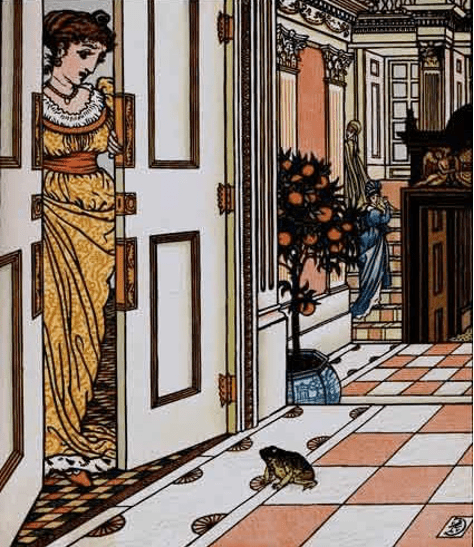
Illustration for The Frog Prince by Walter Crane, 1874
The animal-groom tale commonly reflects notions of women finding male sexuality ugly, scary, etc. When the frog appears at the palace door, the female’s immediate, outsized fear is remarkable:
Frightened, she slammed the door and returned to the table. The king saw that her heart was pounding and asked, “Why are you afraid?”
“There is a disgusting frog out there,” she said . . .
. . . “it is a disgusting frog.”
And it becomes clear—though clearest in the first version—why the princess does not want to let him in. The tale is, most of all, about a young (virgin) woman’s (understandable) fear of penetrative sex and her disgust and repugnance for the male member (implied by the frog in his clamminess and earthiness—more representative of the testicles than the penis). But the unwilling bride’s kingly father, representing the patriarchy and ruling over his daughter, commands her to fulfill her bargain and be with the creature. (In the palace, she hardly speaks, but almost always obeys, made compliant by male authority.) So, after the frog has sat with her and eaten from her plate:
When he had eaten all he wanted, he said, “Now I am tired and want to sleep. Take me to your room, make your bed, so that we can lie in it together.”
The princess was horrified when she heard that. She was afraid of the cold frog and did not dare to even touch him, and yet he was supposed to lie next to her in her bed; she began to cry and didn’t want to at all.
There was no helping it; she had to do what her father wanted, but in her heart she was bitterly angry. She picked up the frog with two fingers, carried him to her room, and climbed into bed, but instead of laying him next to herself, she threw him bang! against the wall.
“Now you will leave me in peace, you disgusting frog!”
But when the frog came down onto the bed, he was a handsome young prince, and he was her dear companion, and she held him in esteem as she had promised, and they fell asleep together with pleasure.
The frog enjoyed his meal, but for her every bite stuck in her throat. Finally he said, “I have eaten all I want and am tired. Now carry me to your room and make your bed so that we can go to sleep.”
The princess began to cry and was afraid of the cold frog and did not dare to even touch him, and yet he was supposed to sleep in her beautiful, clean bed.
She picked him up with two fingers, carried him upstairs, and set him in a corner. As she was lying in bed, he came creeping up to her and said, “I am tired, and I want to sleep as well as you do. Pick me up or I’ll tell your father.” With that she became bitterly angry and threw him against the wall with all her might.
“Now you will have your peace, you disgusting frog!”
But when he fell down, he was not a frog, but a prince with beautiful friendly eyes. And he was now, according to her father’s will, her dear companion and husband. He told her how he had been enchanted by a wicked witch, and that she alone could have rescued him from the well, and that tomorrow they would go together to his kingdom. Then they fell asleep.
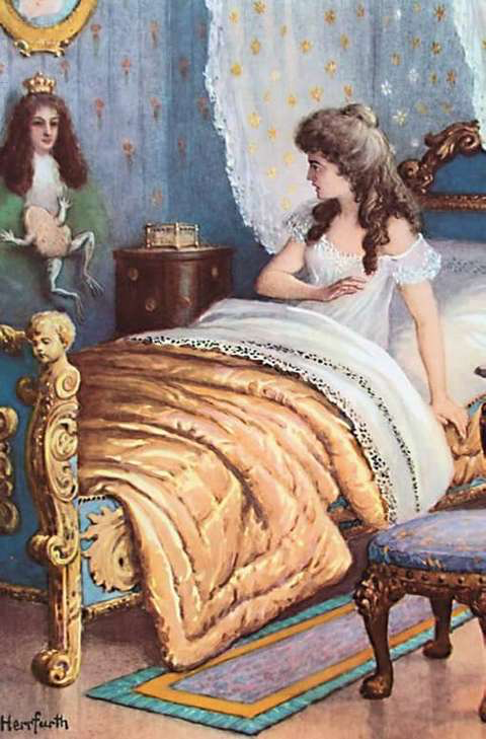
Illustration by Oskar Herrfurth, c. 1920s or earlier
The first version makes the princess’s fear of, anger about, refusal of, and then (after crossing the threshold to enter her bedroom) pleased acceptance of sex (once he is so clearly a “handsome young” man), more obvious: “She was afraid of the cold frog and did not dare to even touch him, and yet he was supposed to lie next to her in her bed” –> “she was bitterly angry . . . instead of laying him next to herself, she threw him bang! against the wall” –> “when the frog came down onto the bed” –> “they fell asleep together with pleasure”. But the revisions turn the story away from its original focus on female sexuality, even female sexual pleasure or excitement by the end, and morph it into a story of female revulsion with or repulsion of male sexuality and anxiety about marriage, resolved by patriarchal command: “he was now, according to her father’s will, her dear companion and husband.”
There’s still the fascinating paradox that it’s only when the virgin, commanded to submit, acts on her anger and fear, violently throwing the creature against the wall (trying to kill him?), that he transforms into the man she can accept, sleep with, and love. (Most variations on the story, from different countries, involve the princess being nasty to the frog at first—some even have her beheading the suitor or tearing him, as a snake, in two.)
But the Grimms’ story isn’t over—it’s capped off with “Iron Heinrich”. The commanded princess is, even after her moment of violent refusal, dismissed by the end, which sees the prince reunite with his servant, who “had had three iron bands put round his heart to stop it bursting with grief and sorrow”. In David Luke’s translation, “Faithful Harry” is “full of joy that his master had been saved”. Unlike the princess, who hadn’t wanted to honour her promise, Heinrich/Harry is—embodying loyalty and strength, seen as German values; the Grimms were nationalists—dutiful, duty-bound, and so thankful for his master’s return, so full of love for him, that his three bands crack apart and fall, “because his master was saved and happy”. Thus ends the story, with its true love being the male servant’s love for his master. The patriarchy is upheld; only male-male, class-bound love can be trusted. The end, happily ever after?!?
Illustration for The Frog Prince by Walter Crane, 1874
Works Cited
Ashliman, D. L. “The Frog King or Iron Heinrich by the Brothers Grimm[:] a comparison of the versions of 1812 and 1857.” Folklore and Mythology Electronic Texts, https://sites.pitt.edu/~dash/frogking.html, revised 30 Nov. 2005.
Grimm, Jacob and Wilhelm. “The Stubborn Child.” c. 1819. Translated by Jack Zipes (with emendations according to the original German, where the neuter was used for the child).
—. “The Frog King, or Iron Harry.” 1857. Selected Tales. 1982. Translated by David Luke, Penguin, 2004, pp. 271-74.
—. The Frog Prince. Illustrated by Walter Crane. George Routledge and Sons, 1874.
Tan, Shaun. The Singing Bones. Arthur A. Levine, 2016.
The author, a professor of literature, has written and published this blog post for educational, critical, and analytical purposes. All images are included only to bolster the post’s argument and to further its educational purpose.