Chapter VII of Winnie-the-Pooh (1926) offers one of the most sanitized titles in children’s literature: “In Which Kanga and Baby Roo Come to the Forest, and Piglet Has a Bath”. It’s a cover-up, not a clean-up. For honesty’s sake, it should be: “In Which Rabbit Devises and Carries Out a Plan to Rid the Forest of Kanga and Roo (But They Stay).” Because this is the chapter where Rabbit enlists Pooh and Piglet in abducting a baby, to force his mother out of their neighbourhood.
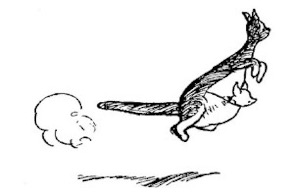
And just how, exactly, does A. A. Milne’s classic seem to anticipate, six years later, the Lindbergh kidnapping case? Well, Rabbit comes up with an elaborate, eleven-point “PLAN TO CAPTURE BABY ROO” (only three of its points are actually needed, to wit: a chatty Pooh distracts Kanga; Roo and Piglet are switched, with Piglet put in Kanga’s “pocket”; Rabbit runs off with Roo while Kanga is still distracted).
But why this deception, baby-napping, and fearmongering? It all begins when, with Pooh and Piglet talking to their cunicular pal about the marsupial newcomers to their Forest, Rabbit says, “‘What I don’t like about it is this. Here we are . . . and then, suddenly, we wake up one morning and, what do we find? We find a Strange Animal among us. An animal of whom we have never even heard before! An animal who carries her family about with her in her pocket!’” And this is how we realize that Rabbit is a xenophobe. (The hare-brained plotter’s suspicion and dislike of the Other seems especially unwarranted given that he has many versions of Self at hand—his close relations in the Forest are so numerous that Rabbit is unsure how many pockets he would need for family [“‘Seventeen, isn’t it?’”] and all his friends-and-relations make up most of the “Expotition” to find the North Pole.)
It may be that Rabbit is envious of the larger, rabbit-like Kanga having a pouch (“Suppose I carried my family about with me in my pocket”) and being a quicker hopper than he is (his plan begins: “1. General Remarks. Kanga runs faster than any of Us, even Me”). But, whatever the reason, he certainly puts the small(minded) into bigotry, deciding lickety-split on the best course of action: “‘What are we to do about Kanga? . . . The best way would be to steal Baby Roo and hide him, and then when Kanga says, “Where’s Baby Roo?” we say, “Aha!” . . . “Aha!” means “We’ll tell you where Baby Roo is, if you promise to go away from the Forest and never come back.”’” So, in his kidnapping scheme to achieve the Forced Exile of the Strange Animal(s), Rabbit, all anti-immigration but still with some heart, sees no need for a ransom note or proof-of-hostage—his demand, in the form of emotional blackmail, can be delivered in person.
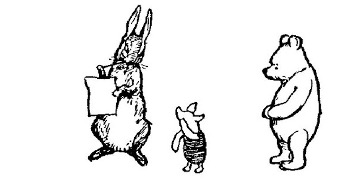
And Rabbit’s accomplices? They’re playing follow-the-leader: timid little Piglet is concerned that Kanga is “‘One of the Fiercer Animals’”, Pooh gets caught up in trying to say “Aha!” ever so meaningfully, and both become preoccupied with how useful they will be to Rabbit, who is, clearly, the Ringleader, soon reading his plan to his two helpers, “listening very eagerly with their mouths open”. (If E. H. Shepard had illustrated that scene, it would have been near-impossible not to read it as political satire of unthinking party loyalists or a kleptocrat’s lackeys.)
Besides, Rabbit’s plan fails. Once Kanga realizes who was slipped into her pocket, she isn’t worried because she knows that Christopher Robin will set all to rights. (It’s poor little Piglet, unfairly, who bears the brunt of Rabbit’s nefarious scheme—Kanga goes along with the pretense that Piglet is Roo, and gives him mouthfuls of washcloth and soap and medicine before bed, only for Christopher Robin to come and join in on the joke; Piglet flees.) In the end, identities are reasserted, relationships repaired, and new pal-pairs established for Twosdays: “So Kanga and Roo stayed in the Forest. And every Tuesday Roo spent the day with his great friend Rabbit, and every Tuesday Kanga spent the day with her great friend Pooh, teaching him to jump, and every Tuesday Piglet spent the day with his great friend Christopher Robin. So they were all happy again.”
So, then, the child reader could see Rabbit’s xenophobia as a warning—don’t be petty or prejudiced against the new kid (in your family/at school/in your neighbourhood)! After all, once the bewhiskered, scut-tailed abductor takes his tot-target home, he takes to him: “Rabbit was playing with Baby Roo in his own house, and feeling more fond of him every minute”. So, learn to accept and welcome a “Strange Other”—soon they will no longer be strange nor seem so other!
But what if Rabbit himself is the warning? What if he’s a Bad Friend?
Rabbit, who is first shown as a misanthrope (before extending his dislike of local others to hoppier immigrants), repeatedly blurs the line between making someone feel useful and using them. We first meet him by visiting his hidey-hole with Pooh—he asks, “‘Is anybody at home?’”, Rabbit answers “‘Nobody’”, changes his voice to pretend it isn’t him, next says he is visiting Pooh, and then, when he sees that it is Pooh, declares, “‘One can’t have anybody coming into one’s house. One has to be careful.’” (Rabbit repeats this it’s-not-me charade when Pooh meets him, face-to-face, to tell him about the Expotition! And at the party to celebrate Pooh’s discovery of the Pole, glum old Eeyore notes that it was “‘last week or the week before that Rabbit bumped into me and said “Bother!”’”) After Pooh partakes of too much condensed milk and honey, and gets stuck in Rabbit’s front door, Rabbit uses his back legs to hang his towels and then his laundry on. And, for Rabbit’s Roo-napping plot, he plays up how “‘Useful’” Piglet and Pooh will be, though Piglet’s use is based on his size-and-shape resemblance to Roo, and Rabbit still directs Pooh to natter on and then verbally distracts Kanga, too, as if he doesn’t trust the bear to fulfill his role in the plan.
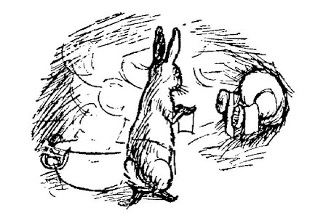
Rabbit’s bad friend-ness is made all the more obvious by Pooh being a considerate, thoughtful friend. When he becomes stuck in Rabbit’s front door, the bear, slightly sorrowful, tells Christopher Robin that he’s worried “‘that Rabbit might never be able to use his front door again. And I should hate that’”. And Pooh, like Piglet, involves himself in Operation KangaRoomoval only to help out his friend, that is, to feel useful: “[Piglet] could hardly sit still, he was so eager to begin being useful at once. . . . ‘What about me?’ said Pooh. ‘I suppose I shan’t be useful?’” (Rabbit both assuages and entices him: “‘Without Pooh . . . the adventure would be impossible.’”)
Why, especially with his many relations and so much family, whom he seems to feel more comfortable around, not to mention Christopher Robin (Rabbit’s given pride-of-place at the head of the Expotition alongside the boy, who confides in Rabbit that he’s not sure what the North Pole looks like), does Rabbit have any non-related animals as friends? It seems that he’s learned, grudgingly, to put up with his neighbours (when he can’t put them off with pretending-to-not-be-himself) and then to make convenient use of them: as towel-horses, or accomplices. The other animals, especially kind-hearted Pooh and eager-to-be-seen Piglet, take this for friendship . . . but the reader doesn’t have to. And so, in Winnie-the-Pooh, much as Owl isn’t really a character but a caricature of the pompous intellectual, Rabbit isn’t really a character but an object-lesson in overcoming prejudice and a warning (a Cautionary Tail?) to the young child about False Friends.
Works Cited
Milne, A. A. Winnie-the-Pooh. Illustrated by Ernest H. Shepard. 1926.
The author, a professor of literature, has written and published this blog post for educational, critical, and analytical purposes. All images are included only to bolster the post’s argument and to further its educational purpose.
 How racist is Peter Pan? (and other questions about children's literature you never knew you wanted answered)