One [legacy of Watergate] is a lingering skepticism of institutions and the individuals who head them, contempt for authority figures, distrust of the influence of money in politics, and deep doubts of the schoolboy verities of the civics class, especially the twin notions that nobility resides in government and that noble principles animate those who govern us.
—David Shribman, “Watergate left North America a different place” (2012)
As the United States entered the 1970s, the decade of its bicentennial, the country was embroiled in the Vietnam War and led by Richard Milhous Nixon, who had got into the White House, in 1968, on a margin of just 31 electoral votes. Then, in the 1972 election, Nixon won all but 18 electoral votes, nabbing the greatest share of the popular vote for a Republican and scoring the fifth-greatest margin of victory ever. Just two years later, Nixon announced military withdrawal from Vietnam—concluding a shameful, war crimes-riddled, failed effort to thwart Communist rule—and then, facing impeachment for Watergate, Nixon resigned, his name (and the sneering nickname “Tricky Dicky”) synonymous with presidential corruption, deceit, and disgrace.
And then, in 1978, came The Great Gilly Hopkins.
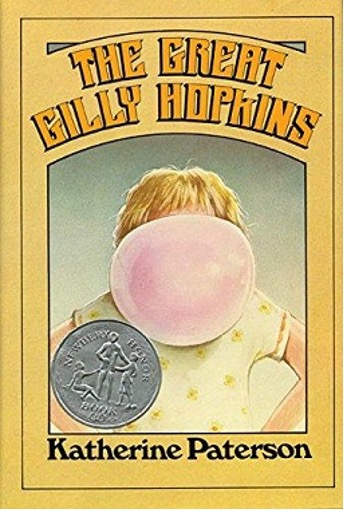
Katherine Paterson’s gritty novel concerns an 11-year-old girl in (fictional) Thompson Park, on the sprawling-into-Maryland outskirts of Washington, D.C. There, in September 1976, Galadriel “Gilly” Hopkins, fancying herself too feisty and smart to handle, finds herself placed with a new foster mom, Maimie Trotter, and her other charge, little W. E. (William Ernest) Teague.
Gilly, who tries to build herself up by looking down and lashing out, sneers at her new guardian’s size, wanting to see her as a trotter (she even thinks of her, nastily, as “lard face”). What Gilly—who wants to see herself as better than others, with a white birth mother she refers to by her full WASP name, Courtney Rutherford Hopkins—doesn’t want to admit to is why Trotter may be overweight: poverty. It’s why Gilly gets a “free lunch” at school and, when she gets home, chocolate chip cookies for a snack. Poor Americans can’t often afford to eat well, and nutrient-poor food, as in Trotter’s house, is often cheapest and easiest to buy and make. But it was in The Great Gilly Hopkins’ decade that so much American food became poorer, cheapened by corn, because of an even whiter house just minutes’ drive away.
The government-pushed glut began in 1973, when the Nixon administration’s Secretary of Agriculture, Earl Butz, set out the Farm Bill, seeding the way for a government-subsidy program for corn producers. That led, by the cracked logic of the free market, to tons upon tons of cheap, surplus corn that’s made its way into about a quarter of American food, mostly as a cheap, empty-calorie sugar substitute. The documentary King Corn (2007) has chalk-outlined the results: sharp increases in obesity and diabetes, and a drop in lifespan.
(King Corn offers plenty more harsh, unnatural truths: 1. Corn isn’t really grown—in eighteen minutes, a machine can seed an Iowa acreage with corn altered to tolerate growing so close together, increasing the farm’s yield, the plot can be sprayed with weed-killing “Liberty” herbicide [which the corn’s been made resistant to], and a farmer then waits until it’s harvest time. 2. It’s hardly corn, but an inedible, genetically-modified, nutrition-depleted version of the dominant Yellow Dent strain. 3. It’s not just nutrient-starved but unnaturally abundant and dangerous—cattle can be fattened with so much so quickly that they develop acidosis, so the corn has to be laced with antibiotics before it’s fed to what becomes American beef. 4. It’s usually not coming to us as corn, but as corn-fed beef or corn syrup-sweetened soda. And, as Elizabeth Kolbert and others have noted, in the U.S., corn’s converted into billions of gallons of ethanol blended into gasoline, as government-mandated, and that shift of corn from groceries to gas raises commodity prices, leading farmers to turn more marshes and woods into cropland, increasing C02.)
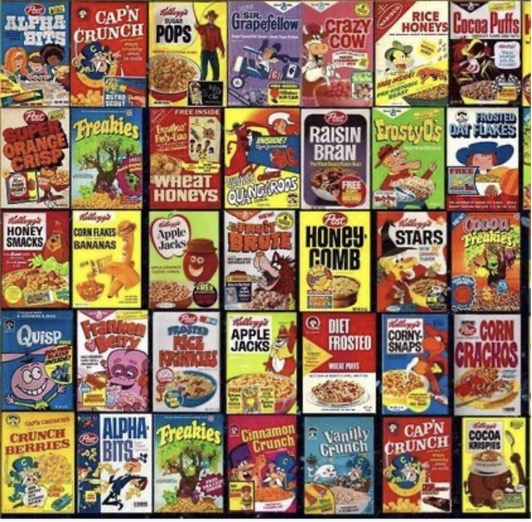
Little surprise, then, that, through the ’70s and into the ’80s, cornier or corn-syrupier, more sugary cereals (Cap’n Crunch, Cocoa Puffs, Corn Crackos, Corny Snaps, Freakies, Frosty O’s, Honey Smacks, Sugar Pops, and other boxed-up brands on supermarket shelves), some offering toys inside, were eaten, more and more, by American kids saucer-eyeing Saturday morning cartoons: Pebbles and Bamm-Bamm, Grape Ape, Bullwinkle, Scooby-Doo, Pink Panther, Speed Buggy, Jetsons, Fat Albert, and other antic animations boxed-up on the small screen. Although there’s no mention of Saturday morning cartoon-watching in Paterson’s novel (still, Agnes does smile like a “cartoon cat” at Gilly in the school cafeteria), Gilly is a very TV-aware tween, thinking little of Trotter’s antennaed black-and-white set or, at first, the educational shows, like Sesame Street, that W. E. watches on it. And the girl’s notion that hitchhikers are always being killed, her imagined mobster nicknames for W. E., her sense of her black teacher, Miss Harris, as the computer HAL gone haywire, and her impersonation of a Bogart tough show her film influences.
It’s the small screen that gives Gilly her crowning idea—a prank sure to show her as both unmanageable and too clever for her, or anyone’s, good:
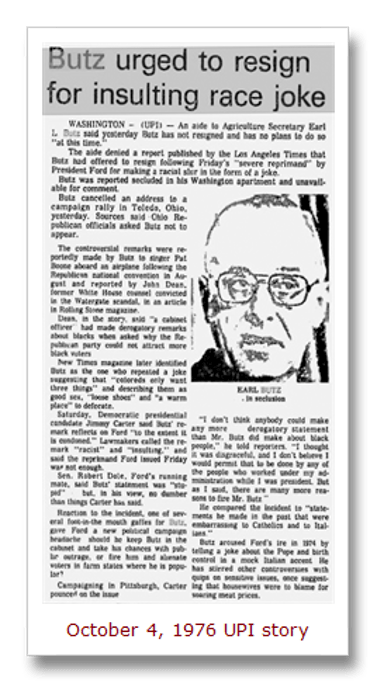
It was TV that gave her the clue. . . . somehow [the news broadcast] began sending a message into her brain. A high government official had told a joke on an airplane that had gotten him fired. Not just any joke, mind you. A dirty joke. But that wasn’t what got him fired. The dirty joke had been somehow insulting to blacks. . . . She now knew something that might be a key to Harris-6.
That “high government official”? Earl Butz. The “joke” he told on a commercial flight was reported to Time and Rolling Stone, another magazine figured out who said it, and the story broke from there. But Butz’s joke was utterly reflective of his previous boss (and the administration?), because Nixon’s vile racism came out on Oval Office tapes released fifteen years after his death, including the comment, just after the Roe v. Wade Supreme Court decision, that abortion is sometimes necessary, as in cases of black-and-white couples having children.
It’s this anti-miscegenation (race-mixing) stigma—which ran especially deep in the American South, though countless slaveowners ignored it when personally convenient—that Gilly unthinkingly continues when she’s asked by Trotter to help bring the neighbour, blind Mr. Randolph, over for dinner, and Gilly, finding the man to be black, is scared by him, running back to Trotter and saying, “‘I never touched one of those people in my life.’”
So, when racism trickles down again from the Nixon administration via the news, Gilly’s brainwave about (mis)harassing Miss Harris leads her to craft a card with a picture of a black woman from a magazine on the front, and she writes:
THEY’RE SAYING “BLACK IS BEAUTIFUL!”
Then below the picture:
BUT THE BEST THAT I CAN FIGGER
IS EVERYONE WHO’S SAYING SO
LOOKS MIGHTY LIKE A
And inside in tiny letters:
PERSON WITH A VESTED INTEREST IN
MAINTAINING THIS POINT OF VIEW.
Thus Gilly Hopkins racially insults the teacher who, on her first day in Grade 6, revealed to our hero the truth of her name: “‘Galadriel Hopkins. What a beautiful name! From Tolkien, of course.’”
But it is, slowly but surely, in reading, not TV, and in letting herself be taught by those she wanted to see as Other, as Lesser, that Gilly finds and develops her empathy and understanding, leaving her bigotry behind. Miss Harris doesn’t visibly react to the card but later, in private, tells Gilly that they are much more similar than she thinks—they both struggle with anger—and, even after she must leave Thompson Park behind, Gilly corresponds with Miss Harris, who sends her The Lord of the Rings, which she starts to devour. As for Mr. Randolph, he has Gilly read a poem from his Oxford Book of English Verse, and Gilly becomes privately enraptured, too, by it—Wordsworth’s “Ode: Intimations of Immortality from Recollections of Early Childhood.” Poetry leads the child to begin, steadily and surely, to harmonize with a man she had wanted to disdain.
But Gilly is a Nixon-era kid: soon after arriving at Trotter’s, she “flashed her crooked-politician smile” at W. E.; when she’s so set on stealing the money in Mr. Randolph’s bookcase to buy a bus ticket to get to her birth mom and has to endure what’s on TV, she “jiggled her foot through . . . the bribery trial of a congressman from who cared where”; she justifies conning Trotter and Mr. Randolph by thinking that “People were so dumb sometimes you almost felt bad to take advantage of them—but not too bad. Not when it was your only way to get where you had to go.”
And Gilly’s dream—reuniting with Courtney—is an American delusion. She props it up with a false belief in good, clean, upstanding whiteness—“families like Courtney’s did not eat with colored people”, she thinks—but soon unlearns her prejudice through experience, care (caring for Mr. Randolph when he, Trotter, and W. E. fall ill before Thanksgiving), and reading. Then she gets the harshest lesson of all, when Courtney arrives for only two days, paid to come by her mother. She still doesn’t want blonde (and blue-eyed?) Gilly.
So, that’s when a tearful Gilly calls Trotter, who consoles the girl with her soothing voice, “I love you”s, and hard truths, including one about white entitlement: “‘you just fool yourself if you expect good things all the time. They ain’t what’s regular—don’t nobody owe ’em to you.’” In 1976, the bicentennial of America’s independence, with the country still contending with counterculture movements, as the stain of the Vietnam War spread, and after Watergate had sparked “a lingering skepticism of institutions and the individuals who head them, contempt for authority figures, [and] distrust of the influence of money in politics”, the great Gilly Hopkins’ lesson about white entitlement, a lesson in “the pursuit of happiness”—that constant struggle for the betterment of civil society—was one that white America was only just starting to learn.
Works Cited and Consulted
Paterson, Katherine. The Great Gilly Hopkins. 1978. Revised ed., Harper Trophy, 2004.
King Corn. Directed by Aaron Wolf, Balcony, 2007.
Kolbert, Elizabeth. “Do We Need Another Green Revolution?” The New Yorker, 23 June 2025, http://www.newyorker.com/magazine/2025/06/30/do-we-need-another-green-revolution.
Shribman, David. “Watergate left North America a different place.” The Globe and Mail, 16 June 2012.
The author, a professor of literature, has written and published this blog post for educational, critical, and analytical purposes. All images are included only to bolster the post’s argument and to further its educational purpose.


 How racist is Peter Pan? (and other questions about children's literature you never knew you wanted answered)